• Home
  • Apps
  • About Us
  • Contact Us


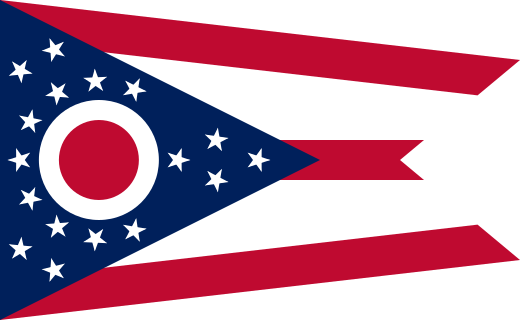
Ohio Flag Ohio


Ohio Content Standard for Geography

The full standard is available on the state website for Content Standards . This page provides some activities to help meet the geography strand for Kindergarten through Grade 8. The Ohio Department of Education identifies three topics under the geography strand:
  • Spatial Thinking and Skills
  • Places and Regions
  • Human Systems

Grade Kindergarten

Theme: A Child’s Place in Time and Space

Standards


Spatial Thinking and Skills
  1. Terms related to direction and distance, as well as symbols and landmarks, can be used to talk about the relative location of familiar places.
  2. Models and maps represent places.
Human Systems
  1. Humans depend on and impact the physical environment in order to supply food, clothing and shelter.
  2. Individuals are unique but share common characteristics of multiple groups.

Activities

  • Use our JigsawGeo iOS game with the United States map. The Easy level challenges them to place all 50 states in their correct positions in the lowest time. For children that cannot yet spell, the app includes a voice-over narrative that says the name of each state as they play. The easy level also helps them by slowly zooming in on the correct location for each state.
  • Use our USA Fifty States Flash Cards to learn the name of each state.
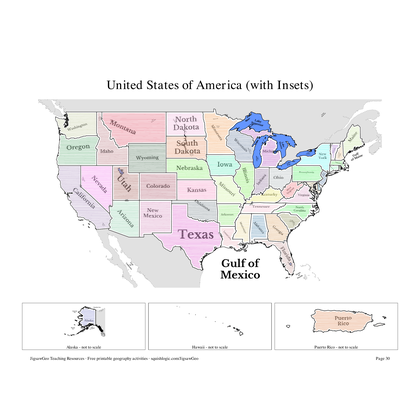
  • Print out our free  USA map.  It has multiple sheets to support various learning outcomes related to the geography of the United States. You may photocopy it freely to use in your class.
    • Use it as a coloring page -- have your students color in Ohio and each state where they have a relative.

Grade One

First Grade Theme: Families Now and Long Ago, Near and Far

Standards


Spatial Thinking and Skills
  1. Maps can be used to locate and identify places.
Places and Regions
  1. Places are distinctive because of their physical characteristics (landforms and bodies of water) and human characteristics (structures built by people).
Human Systems
  1. Families interact with the physical environment differently in different times and places.
  2. Diverse cultural practices address basic human needs in various ways and may change over time.

Activities

  • Use our JigsawGeo iOS game with the United States map. The Easy level challenges them to place all 50 states in their correct positions in the lowest time. For children that cannot yet spell, the app includes a voice-over narrative that says the name of each state as they play. The easy level also helps them by slowly zooming in on the correct location for each state.
  • Use our USA Fifty States Flash Cards to learn the name of each state.
  • Print out our free  USA map.  It has multiple sheets to support various learning outcomes related to the geography of the United States. You may photocopy it freely to use in your class.
    • Use it as a coloring page -- have your students color in Ohio and each state where they have a relative.
    • Use it for a quiz (have your students find Ohio on the map).

Grade Two

Second Grade Theme: People Working Together

Standards


Spatial Thinking and Skills
  1. Maps and their symbols can be interpreted to answer questions about location of places.
Places and Regions
  1. The work that people do is impacted by the distinctive human and physical characteristics in the place where they live.
Human Systems
  1. Human activities alter the physical environment, both positively and negatively.
  2. Cultures develop in unique ways, in part through the influence of the physical environment.
  3. nteractions among cultures lead to sharing ways of life.

Activities

  • Use our JigsawGeo iOS game with the United States map. The Easy level challenges them to place all 50 states in their correct positions in the lowest time. For children that cannot yet spell, the app includes a voice-over narrative that says the name of each state as they play. The easy level also helps them by slowly zooming in on the correct location for each state.
  • Use our USA Fifty States Flash Cards to learn the name of each state.
  • Print out our free  USA map.  It has multiple sheets to support various learning outcomes related to the geography of the United States. You may photocopy it freely to use in your class.
    • Use it as a coloring page -- have your students color in Ohio and each state where they have a relative.
    • Use it for a quiz (have your students find Ohio on the map).

Grade Three

Thrid Grade Theme: Communities: Past and Present, Near and Far

Standards


Spatial Thinking and Skills
  1. Physical and political maps have distinctive characteristics and purposes. Places can be located on a map by using the title, key, alphanumeric grid and cardinal directions.
Places and Regions
  1. Daily life is influenced by the agriculture, industry and natural resources in different communities.
Human Systems
  1. Evidence of human modification of the environment can be observed in the local community.
  2. Systemsoftransportationandcommunicationmove people, products and ideas from place to place.
  3. Communities may include diverse cultural groups.

Activities

  • Use our JigsawGeo iOS game with the United States map. The Easy level challenges them to place all 50 states in their correct positions in the lowest time. For children that cannot yet spell, the app includes a voice-over narrative that says the name of each state as they play. The easy level also helps them by slowly zooming in on the correct location for each state. Higher levels challenge them to find states by their capital, or by the state flag.
  • Use our USA Fifty States Flash Cards to learn the name of each state.
  • Print out our free  USA map.  It has multiple sheets to support various learning outcomes related to the geography of the United States. You may photocopy it freely to use in your class.
    • Use it as a coloring page -- have your students color in Ohio and each state where they have a relative.
    • Teach map reading skills using the grid page, which provides an alphanumeric grid to locate each state (and an optional answer key on the next page).
    • Use it for a quiz (have your students find Ohio on the map).

Grade Four

Fourth Grade Theme: Ohio in the United States

Standards


Spatial Thinking and Skills
  1. A map scale and cardinal and intermediate directions can be used to describe the relative location of physical and human characteristics of Ohio and the United States.
Places and Regions
  1. The economic development of the United States continues to influence and be influenced by agriculture, industry and natural resources in Ohio.
  2. The regions of the United States known as the North, South and West developed in the early 1800s largely based on their physical environments and economies.
Human Systems
  1. People have modified the environment since prehistoric times. There are both positive and negative consequences for modifying the environment in Ohio and the United States.
  2. The population of the United States has changed over time, becoming more diverse (e.g., racial, ethnic, linguistic, religious). Ohio’s population has become increasingly reflective of the cultural diversity of the United States.
  3. Ohio’s location and its transportation systems continue to influence the movement of people, products and ideas in the United States.

Activities

  • Use our JigsawGeo iOS game with the United States map. The Easy level challenges them to place all 50 states in their correct positions in the lowest time. For children that cannot yet spell, the app includes a voice-over narrative that says the name of each state as they play. The easy level also helps them by slowly zooming in on the correct location for each state. Higher levels challenge them to find states by their capital, or by the state flag.
  • Use our USA Fifty States Flash Cards to learn the name of each state.
    • Learn state name
    • Learn state capital
  • Print out our free  USA map.  It has multiple sheets to support various learning outcomes related to the geography of the United States. You may photocopy it freely to use in your class.
    • Have students color the states using a legend such as major industry types or a heat map such as population (use Wikipedia to get list of populations by state).
    • Use the map to learn where Ohio is located in relation to other states.
    • Use the map for a quiz (have your students find Ohio and other states on the map).

Grade Five

Fifth Grade Theme: Regions and People of the Western Hemisphere

Standards


Spatial Thinking and Skills
  1. Globes and other geographic tools can be used to gather, process and report information about people, places and environments. Cartographers decide which information to include in maps.
  2. Latitude and longitude can be used to make observations about location and generalizations about climate.
Places and Regions
  1. Regions can be determined using various criteria (e.g., landform, climate, population, cultural or economic).
Human Systems
  1. Variations among physical environments within the Western Hemisphere influence human activities. Human activities also alter the physical environment.
  2. American Indians developed unique cultures with many different ways of life. American Indian tribes and nations can be classified into cultural groups based on geographic and cultural similarities.
  3. Political, environmental, social and economic factors cause people, products and ideas to move from place to place in the Western Hemisphere today.
  4. The Western Hemisphere is culturally diverse due to American Indian, European, Asian and African influences and interactions, as evidenced by artistic expression, language, religion and food.

Activities

  • Use our JigsawGeo iOS game with the United States map. The Easy level challenges them to place all 50 states in their correct positions in the lowest time. For children that cannot yet spell, the app includes a voice-over narrative that says the name of each state as they play. The easy level also helps them by slowly zooming in on the correct location for each state. Higher levels challenge them to find states by their capital, or by the state flag.
  • Use our USA Fifty States Flash Cards to learn the name of each state.
    • Learn state name
    • Learn state capital
  • Print out our free  USA map.  It has multiple sheets to support various learning outcomes related to the geography of the United States. You may photocopy it freely to use in your class.
    • Have students color the states using a legend such as major industry types or a heat map such as population.
    • Teach map reading skills with the final sheet of the map, which shows latitude and longitude, along with a distance scale and a compass.
    • Use the map to learn where Ohio is located in relation to other states.
    • Label the blank map with the locations of Native American tribes.
    • Use the map for a quiz (have your students find Ohio and other states on the map).