• Home
  • Apps
  • About Us
  • Contact Us


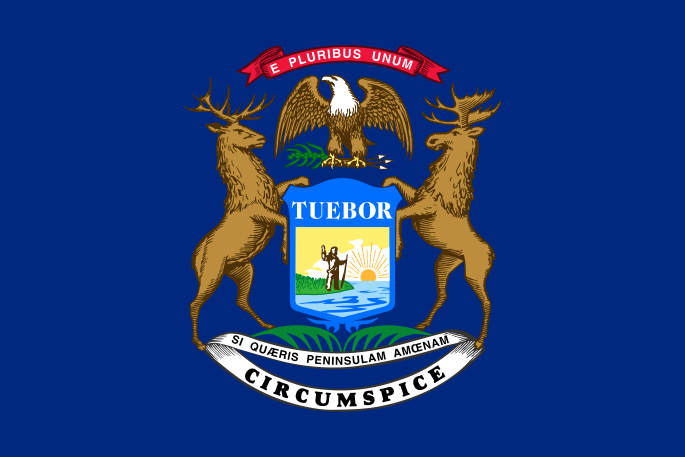
Michigan Flag Michigan


Michigan Content Standard for Geography

The full standard is available on the state website for Content Standards . This page provides some activities to help meet the grade level content expectations for geography. The Michigan Department of Education six standard categories for geography.
  • G1 The World in Spatial Terms: Geographical Habits of Mind
    • 1.1 Spatial Thinking
    • 1.2 Geographical Inquiry and Analysis
    • 1.3 Geographical Understanding
  • G2 Places and Regions
    • 2.1 Physical Characteristics of Place
    • 2.2 Human Characteristics of Place
  • G3 Physical Systems
    • 3.1 Physical Processes
    • 3.2 Ecosystems
  • G4 Human Systems
    • 4.1 Cultural Mosaic
    • 4.2 Patterns of Human Settlement
    • 4.3 Forces of Cooperation and Conflict
    • 4.4 Economic Interdependence
  • G5 Environment and Society
    • 5.1 Humans and the Environment
    • 5.2 Physical and Human Systems
  • G6 Global Issues Past and Present
    • 6.1 Global Topic Investigation and Issue Analysis

Grade Kindergarten

Theme: Myself and Others

Standards


  • G1 The World in Spatial Terms: Use geographic representations to acquire, process, and report information from a spatial perspective
    • K – G1.0.1 Recognize that maps and globes represent places.
    • K – G1.0.2 Use environmental directions or positional words (up/down, in/out, above/below) to identify significant locations in the classroom.
  • G2 Places and Regions: Understand how regions are created from common physical and human characteristics.
    • K – G2.0.1 Identify and describe places in the immediate environment (e.g., classroom, home, playground).
  • G5 Environment and Society: Understand the effects of human-environment interactions.
    • K – G5.0.1 Describe ways people use the environment to meet human needs and wants (e.g., food, shelter, clothing).

Activities

  • Suggest our JigsawGeo iPhone map game to your parents. The Easy level challenges them to place all 50 states in their correct positions in the lowest time. For children that cannot yet spell, the app includes a voice-over narrative that says the name of each state as they play. The easy level also helps them by slowly zooming in on the correct location for each state. Parents can find it on the AppStore by searching for "JigsawGeo".
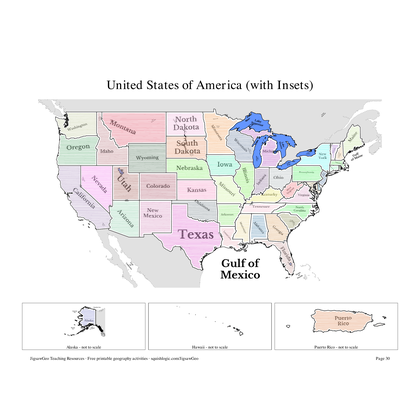
  • Print out our free  USA map.  It has multiple sheets to support various learning outcomes related to the geography of the United States. You may photocopy it freely to use in your class.
    • Use it as a coloring page -- have your students color in Michigan and each state where they have a relative.

Grade One

First Grade Theme: Families and Schools

Standards


  • G1 The World in Spatial Terms: Use geographic representations to acquire, process, and report information from a spatial perspective
    • 1 – G1.0.1 Construct simple maps of the classroom to demonstrate aerial perspective.
    • 1 – G1.0.2 Give examples of places that have absolute locations (e.g., home address, school address).
    • 1 – G1.0.3 Use personal directions (left, right, front, back) to describe the relative location of significant places in the school environment.
    • 1 – G1.0.4 Distinguish between land masses and bodies of water using maps and globes.
  • G2 Places and Regions: Understand how regions are created from common physical and human characteristics.
    • 1 – G2.0.1 Distinguish between physical (e.g., clouds, trees, weather) and human (e.g., buildings, playgrounds, sidewalks) characteristics of places.
    • 1 – G2.0.2 Describe the unifying characteristics and/or boundaries of different school regions (e.g., playground, reading corner, library, restroom).
  • G4 Human Systems: Understand how human activities help shape the Earth’s surface.
    • 1 – G4.0.1 Use components of culture (e.g., foods, language, religion, traditions) to describe diversity in family life.
  • G5 Environment and Society: Understand the effects of human-environment interactions.
    • 1 – G5.0.1 Describe ways in which people modify (e.g., cutting down trees, building roads) and adapt to the environment (e.g., clothing, housing, transportation).

Activities

  • Suggest our JigsawGeo iPhone map game to your parents. The Easy level challenges them to place all 50 states in their correct positions in the lowest time. For children that cannot yet spell, the app includes a voice-over narrative that says the name of each state as they play. The easy level also helps them by slowly zooming in on the correct location for each state. Parents can find it on the AppStore by searching for "JigsawGeo".
  • Print out our free  USA map.  It has multiple sheets to support various learning outcomes related to the geography of the United States. You may photocopy it freely to use in your class.
    • Use it as a coloring page -- have your students color in Michigan and each state where they have a relative. Have them color the Great Lakes and oceans to help them distinguish land masses from bodies of water.
    • Use it for a quiz (have your students find Michigan on the map).

Grade Two

Second Grade Theme: The Local Community

Standards


  • G1 The World in Spatial Terms: Use geographic representations to acquire, process, and report information from a spatial perspective
    • 2 – G1.0.1 Construct maps of the local community that contain symbols, labels, and legends denoting human and natural characteristics of place.
    • 2 – G1.0.2 Use maps to describe the spatial organization of the local community by applying concepts including relative location and using distance, direction, and scale
  • G2 Places and Regions: Understand how regions are created from common physical and human characteristics.
    • 2 – G2.0.1 Compare the physical and human characteristics of the local community with those of another community.
    • 2 – G2.0.2 Describe how the local community is part of a larger region (e.g., county, metropolitan area, state).
  • G4 Human Systems: Understand how human activities help shape the Earth’s surface.
    • 2 – G4.0.1 Describe land use in the community (e.g., where people live, where services are provided, where products are made).
    • 2 – G4.0.2 Describe the means people create for moving people, goods, and ideas within the local community.
    • 2 – G4.0.3 Use components of culture (e.g., foods, language, religion, traditions) to describe diversity in the local community.
  • G5 Environment and Society: Understand the effects of human-environment interactions.
    • 2 – G5.0.1 Suggest ways people can responsibly interact with the environment in the local community.
    • 2 – G5.0.2 Describe positive and negative consequences of changing the physical environment of the local community.

Activities

  • Suggest our JigsawGeo iPhone map game to your parents. The Easy level challenges them to place all 50 states in their correct positions in the lowest time. The easy level also helps them by slowly zooming in on the correct location for each state. Parents can find it on the AppStore by searching for "JigsawGeo".
  • Use our USA Fifty States Flash Cards to learn the name of each state.
  • Print out our free  USA map.  It has multiple sheets to support various learning outcomes related to the geography of the United States. You may photocopy it freely to use in your class.
    • Use it as a coloring page -- have your students color in Michigan and each state where they have a relative.
    • Use it for a quiz (have your students find Michigan on the map).
    • Ask students where one state is in relation to another by direction and distance.

Grade Three:

Thrid Grade Theme: Michigan Studies

Standards


  • G1 The World in Spatial Terms: Use geographic representations to acquire, process, and report information from a spatial perspective
    • 3 – G1.0.1 Use cardinal directions (north, south, east, west) to describe the relative location of significant places in the immediate environment.
    • 3 – G1.0.2 Use thematic maps to identify and describe the physical and human characteristics of Michigan.
  • G2 Places and Regions: Understand how regions are created from common physical and human characteristics.
    • 3 – G2.0.1 Use a variety of visual materials and data sources to describe ways in which Michigan can be divided into regions.
    • 3 – G2.0.2 Describe different regions to which Michigan belongs (e.g., Great Lakes Region, Midwest).
  • G4 Human Systems: Understand how human activities help shape the Earth’s surface.
    • 3 – G4.0.1 Describe major kinds of economic activity in Michigan today, such as agriculture (e.g., corn, cherries, dairy), manufacturing (e.g., automobiles, wood products), services and tourism, research and development (e.g., Automation Alley, life sciences corridor, university communities), and explain the factors influencing the location of these economic activities.
    • 3 – G4.0.2 Describe diverse groups that have come into a region of Michigan and reasons why they came (push/pull factors).
    • 3 – G4.0.3 Describe some of the current movements of goods, people, jobs or information to, from, or within Michigan and explain reasons for the movements. (E)
    • 3 – G4.0.4 Use data and current information about the Anishinaabeg and other American Indians living in Michigan today to describe the cultural aspects of modern American Indian life; give an example of how another cultural group in Michigan today has preserved and built upon its cultural heritage.
  • G5 Environment and Society: Understand the effects of human-environment interactions.
    • 3 – G5.0.1 Locate natural resources in Michigan and explain the consequences of their use.
    • 3 – G5.0.2 Describe how people adapt to, use, and modify the natural resources of Michigan. (H)

Activities

  • Suggest our JigsawGeo iPhone map game to your parents. The Easy level challenges them to place all 50 states in their correct positions in the lowest time. Higher levels challenge them to find states by their capital, or by the state flag. Parents can find it on the AppStore by searching for "JigsawGeo".
  • Use our USA Fifty States Flash Cards to learn the name of each state.
  • Print out our free  USA map.  It has multiple sheets to support various learning outcomes related to the geography of the United States. You may photocopy it freely to use in your class.
    • Use it as a coloring page -- have your students color in Michigan and each state where they have a relative.
    • Teach map reading skills using the grid page, which provides an alphanumeric grid to locate each state (and an optional answer key on the next page).
    • Use it for a quiz (have your students find Michigan on the map).

Grade Four

Fourth Grade Theme:

Standards


Activities

  • Suggest our JigsawGeo iPhone map game to your parents. The Easy level challenges them to place all 50 states in their correct positions in the lowest time. Higher levels challenge them to find states by their capital, or by the state flag. Parents can find it on the AppStore by searching for "JigsawGeo".
  • Use our USA Fifty States Flash Cards to learn the name of each state.
    • Learn state name
    • Learn state capital
  • Print out our free  USA map.  It has multiple sheets to support various learning outcomes related to the geography of the United States. You may photocopy it freely to use in your class.
    • Have students color the states using a legend such as major industry types or a heat map such as population (they can use the State Population data from wikipedia)
    • Use the map to learn where Michigan is located in relation to other states.
    • Use the map for a quiz (have your students find Michigan and other states on the map).

Grade Five

Fifth Grade Theme: Regions and People of the Western Hemisphere

Standards


Spatial Thinking and Skills
  1. Globes and other geographic tools can be used to gather, process and report information about people, places and environments. Cartographers decide which information to include in maps.
  2. Latitude and longitude can be used to make observations about location and generalizations about climate.
Places and Regions
  1. Regions can be determined using various criteria (e.g., landform, climate, population, cultural or economic).
Human Systems
  1. Variations among physical environments within the Western Hemisphere influence human activities. Human activities also alter the physical environment.
  2. American Indians developed unique cultures with many different ways of life. American Indian tribes and nations can be classified into cultural groups based on geographic and cultural similarities.
  3. Political, environmental, social and economic factors cause people, products and ideas to move from place to place in the Western Hemisphere today.
  4. The Western Hemisphere is culturally diverse due to American Indian, European, Asian and African influences and interactions, as evidenced by artistic expression, language, religion and food.

Activities

  • Suggest our JigsawGeo iPhone map game to your parents. The Easy level challenges them to place all 50 states in their correct positions in the lowest time. Higher levels challenge them to find states by their capital, or by the state flag. Parents can find it on the AppStore by searching for "JigsawGeo".
  • Use our USA Fifty States Flash Cards to learn the name of each state.
    • Learn state name
    • Learn state capital
  • Print out our free  USA map.  It has multiple sheets to support various learning outcomes related to the geography of the United States. You may photocopy it freely to use in your class.
    • Have students color the states using a legend such as major industry types or a heat map such as population (they can use the State Population data from wikipedia)
    • Teach map reading skills with the final sheet of the map, which shows latitude and longitude, along with a distance scale and a compass.
    • Use the map to learn where Michigan is located in relation to other states.
    • Label the blank map with the locations of Native American tribes.
    • Use the map for a quiz (have your students find Michigan and other states on the map).